01 · What is changing—and what can be established?
Ecological reorganisation means changes in species identity or relative abundance, functional traits or ecological interactions. It is not simply another term for decline: a community can change substantially even if its species count remains stable. Conversely, recording a new species does not by itself demonstrate an altered ecosystem function.
The monograph synthesises scientific literature, historical surveys, mapped habitat estimates, institutional records, structured fisher reports and explicitly bounded author testimony. It presents no new field measurements. Four levels of inference remain distinct: documented condition, comparable change through time, functional consequence and causal attribution. The absence of a suitable time series is not evidence of ecological stability.
02 · Warming, arrival and establishment
Regional research documents sustained warming and changing marine-heatwave exposure, alongside biological redistribution and mortality events. These findings establish regional pressures and possible mechanisms; they do not determine the response of every Parian habitat, depth or species.
Transport pathways such as the Suez Canal, shipping and aquaculture deliver organisms. Temperature then acts as one environmental filter affecting survival, reproduction and spread. Warming does not transport organisms, and arrival does not guarantee establishment. Increasing inventories also reflect detection effort and taxonomic revision. Presence, persistence, spread and measured impact must therefore be assessed separately.
03 · Two species cases, different kinds of evidence
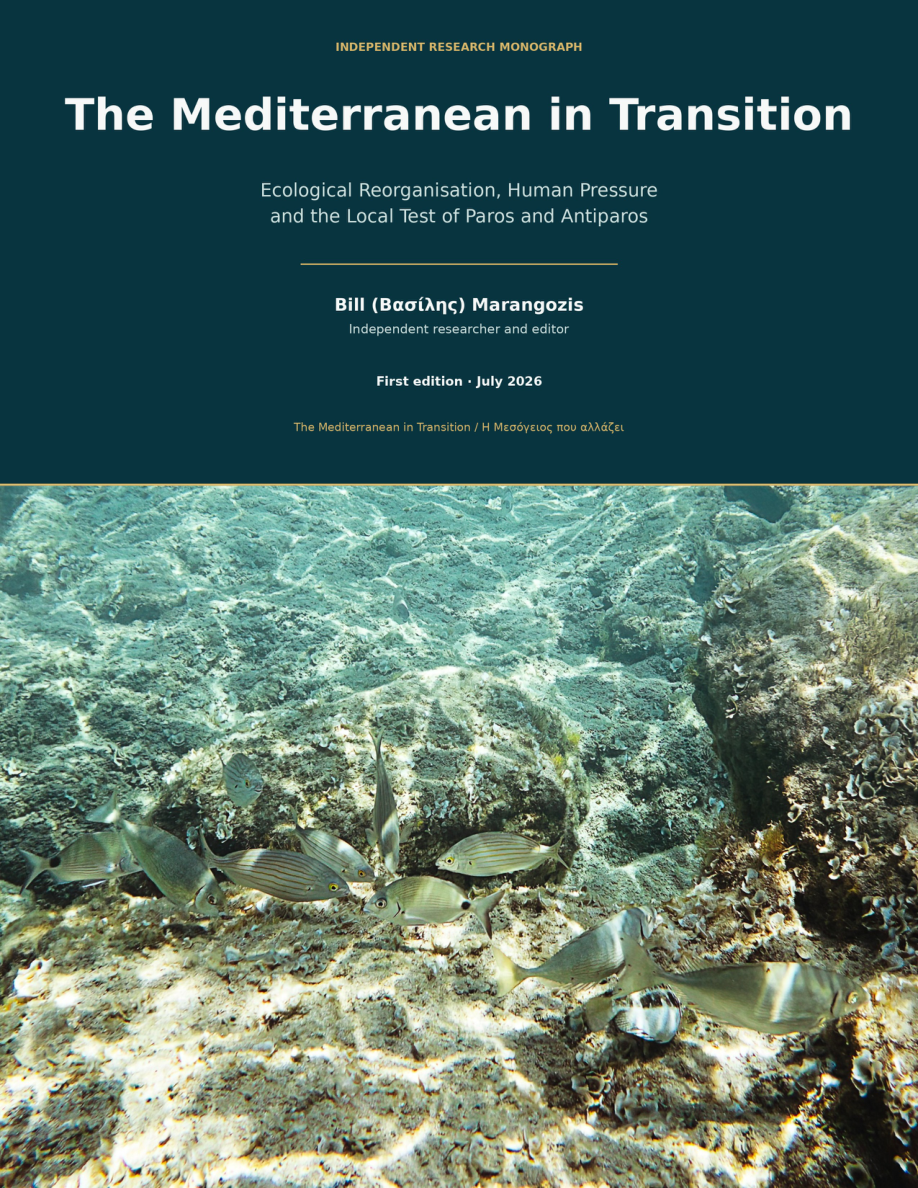
In July 2011, Siganus luridus was recorded at all 14 surveyed shallow stations around Paros and Antiparos and described as the dominant herbivorous fish observed. Extensive barrens were recorded in the same campaign. This establishes co-occurrence, not proof that rabbitfish caused those barrens. Experiments elsewhere show that grazing fishes—and, under other conditions, native sea urchins—can maintain low-algal states. The pressure maintaining a barren need not be the one that originally removed its canopy.
Four later rocky stations received mean vegetation-restricted reef-EBQI classifications of “Bad”. These are station-level macroalgal assessments, not an island-wide diagnosis or a repeated survey of the 2011 sites.
For the silver-cheeked toadfish, Lagocephalus sceleratus, the study documents regional evidence of toxicity, trophic integration and fishery damage. Those findings do not establish local prey depletion or annual economic losses. The species had been reported locally before 2011 but was not detected during that shallow-water survey; non-detection under one protocol does not establish absence elsewhere. Removal totals alone cannot demonstrate population suppression or ecological recovery.
04 · Fishing and human consequences
Fishing is both a driver of ecological change and an activity affected by it. It selectively removes organisms and changes population structure, while responding to markets, regulation and species redistribution. Landings and reconstructed catches cannot substitute for local biomass or effort-standardised observations. Claims that fish are becoming smaller must distinguish growth, population size structure and the composition of catches.
The economic consequences also require separate accounts. Gear damage, forgone catch, extra fuel, household income, public expenditure and habitat value are different quantities. Adaptation may reduce visible damage while increasing other costs; compensation is a transfer, not automatically a net social gain. The study identifies no verified local series linking ecological condition, fishing effort, catches and household welfare. Regional cost estimates cannot simply be multiplied across the Parian fleet.
05 · What the local record contains
The islands are not an ecological blank. Alongside the 2011 survey and later reef assessments, the evidence includes a 2020 Pantieronisi cave record of Urocaridella pulchella, including an egg-bearing female; a documented historical decline and later absence of an Audouin’s-gull breeding colony approaching 2012; mapped seagrass habitat; and professional-fisher reports.
Approximately 36.8 km² of seagrass-category polygons were extracted within the study’s declared bounding box. This is a mapped spatial reference, not a measure of present healthy Posidonia or a habitat trend. The cave observation does not establish persistent occupation or impact; the seabird record does not directly measure underwater prey abundance. Together, these sources form an evidence mosaic, not a common ecological time series.
06 · A practical research and management agenda
First preserve historical coordinates, methods, taxonomic decisions and raw materials. Pilot work should assess detectability, observer effects and feasible precision before repeated monitoring expands. The 14 historical stations and the four later rocky-reef stations must remain separate analytical panels. Revisiting published coordinates is not exact replication unless routes and observer procedures can also be recovered.
Repeated observations should align thermal exposure, benthic condition, fish and grazer size structure, professional and recreational fishing effort, and human consequences. Representative island-wide assessment requires an appropriate spatial sampling design. Intervention evaluation must separately measure ecological effectiveness, livelihoods, safety and distributional effects.
Management need not wait for complete causal attribution where credible harm is serious. Proportionate, reversible precaution can be justified with explicit objectives, duration and review rules. More costly or irreversible measures require stronger support. Proposed new data collection remains a future, inactive phase; it is not work already completed by this study.
The central conclusion
Paros and Antiparos are connected to a changing regional sea. Their existing evidence supports meaningful baselines, testable hypotheses and proportionate action, but does not quantify system-wide ecological reorganisation or allocate its causes. Scientific restraint and practical action can proceed together when each claim and decision remains matched to its evidence.
Companion summary prepared from the supplied file the_mediterranean_in_transition_v0.9(1).pdf, whose publication statement identifies First edition, July 2026. It introduces no new analysis. The full monograph contains the source audit, methods, qualifications and references.
Download the publications
Both summaries include the cover. The full study is supplied in its original English edition.
Marangozis, B. (2026). The Mediterranean in Transition: Ecological Reorganisation, Human Pressure and the Local Test of Paros and Antiparos. First edition, July 2026. Independent research monograph.